Getting started
This guide will walk you through creating a working eval that tests prompts across multiple models and opens a web view for comparing outputs.
After installing promptfoo, you can set up your first config file in a few ways:
Running an example
Set up your first config file with a pre-built example by running this command with npx, npm, or brew:
- npx
- npm
- brew
npx promptfoo@latest init --example getting-started
npm install -g promptfoo
promptfoo init --example getting-started
brew install promptfoo
promptfoo init --example getting-started
This will create a new directory with a basic example that tests translation prompts across different models. The example includes:
- A configuration file
promptfooconfig.yamlwith sample prompts, providers, and test cases. - A
README.mdfile explaining how the example works.
Most providers need authentication. For OpenAI:
export OPENAI_API_KEY=sk-abc123
Then navigate to the example directory, run the eval, and view results:
- npx
- npm
- brew
cd getting-started
npx promptfoo@latest eval
npx promptfoo@latest view
cd getting-started
promptfoo eval
promptfoo view
cd getting-started
promptfoo eval
promptfoo view
Set up via the CLI
To start from scratch, run promptfoo init to create a config through an interactive CLI walkthrough:
- npx
- npm
- brew
npx promptfoo@latest init
promptfoo init
promptfoo init
Set up via the Web UI
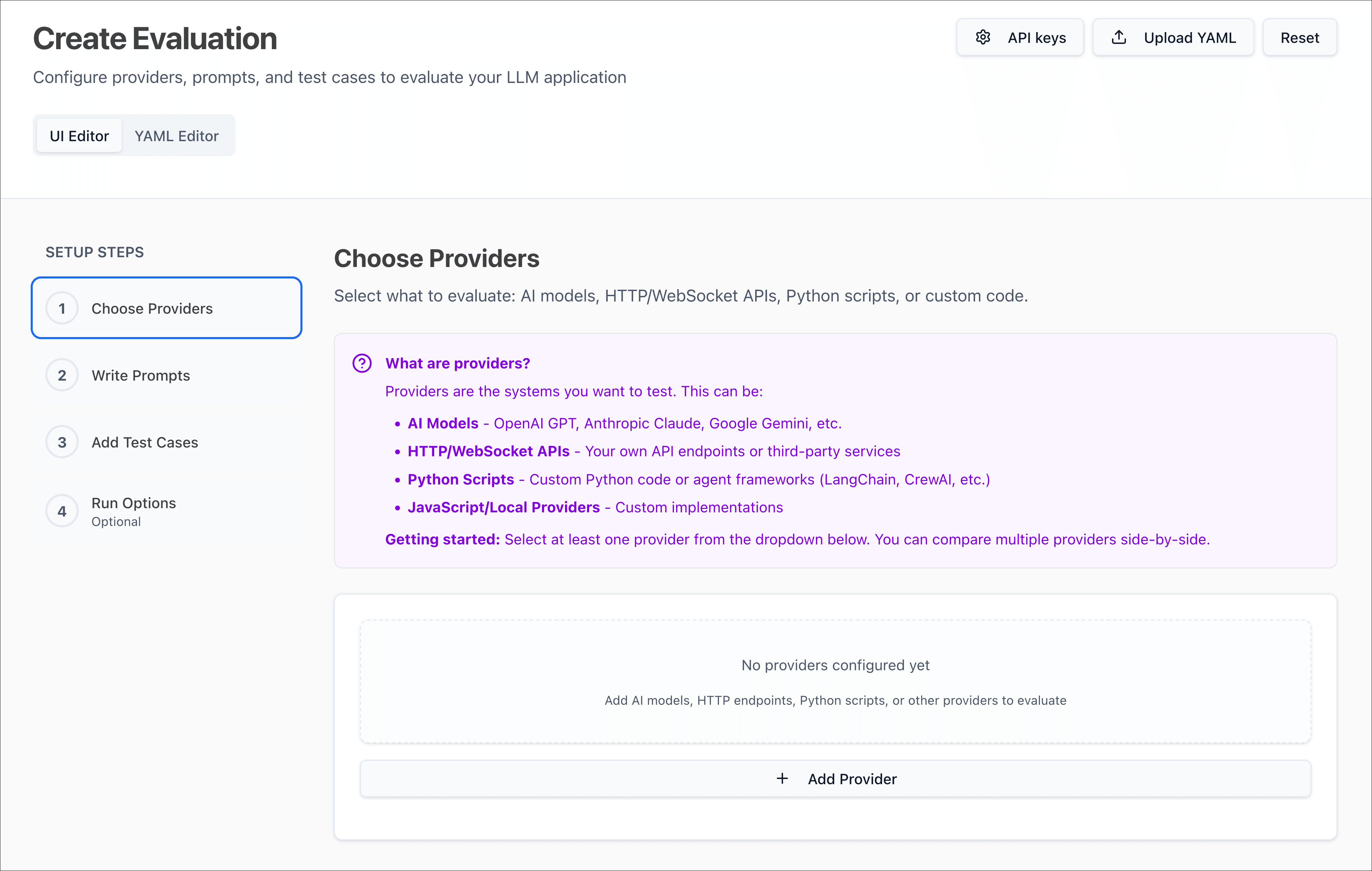
If you prefer a visual interface, run promptfoo eval setup to configure your first eval through the web UI:
- npx
- npm
- brew
npx promptfoo@latest eval setup
promptfoo eval setup
promptfoo eval setup
This opens a browser-based setup flow that walks you through creating prompts, choosing providers, and adding test cases.
Configuration
Now that you've created an initial configuration, you can update promptfooconfig.yaml with your own prompts, providers, and test cases:
-
Set up your prompts: Open
promptfooconfig.yamland add prompts that you want to test. Use double curly braces for variable placeholders:{{variable_name}}. For example:prompts:- 'Convert the following English text to {{language}}: {{input}}' -
Add providers: Add
providersto specify AI models you want to test. Promptfoo supports 60+ providers including OpenAI, Anthropic, Google, and many others:providers:- openai:gpt-6-sol- openai:gpt-6-lunaThis example uses your OpenAI API key. You can also configure Anthropic, Google, local models like Ollama, or custom Python and JavaScript code. Each provider has its own setup requirements.
-
Add test inputs: Add some example inputs for your prompts. Optionally, add assertions to set output requirements that are checked automatically.
For example:
tests:- vars:language: Frenchinput: Hello worldassert:- type: containsvalue: 'Bonjour le monde'- vars:language: Spanishinput: Where is the library?assert:- type: icontainsvalue: 'Dónde está la biblioteca'When writing test cases, think of core use cases and potential failures that you want to make sure your prompts handle correctly.
-
Run the evaluation: Make sure you're in the directory containing
promptfooconfig.yaml, then run:- npx
- npm
- brew
npx promptfoo@latest evalpromptfoo evalpromptfoo evalThis tests every prompt, model, and test case.
-
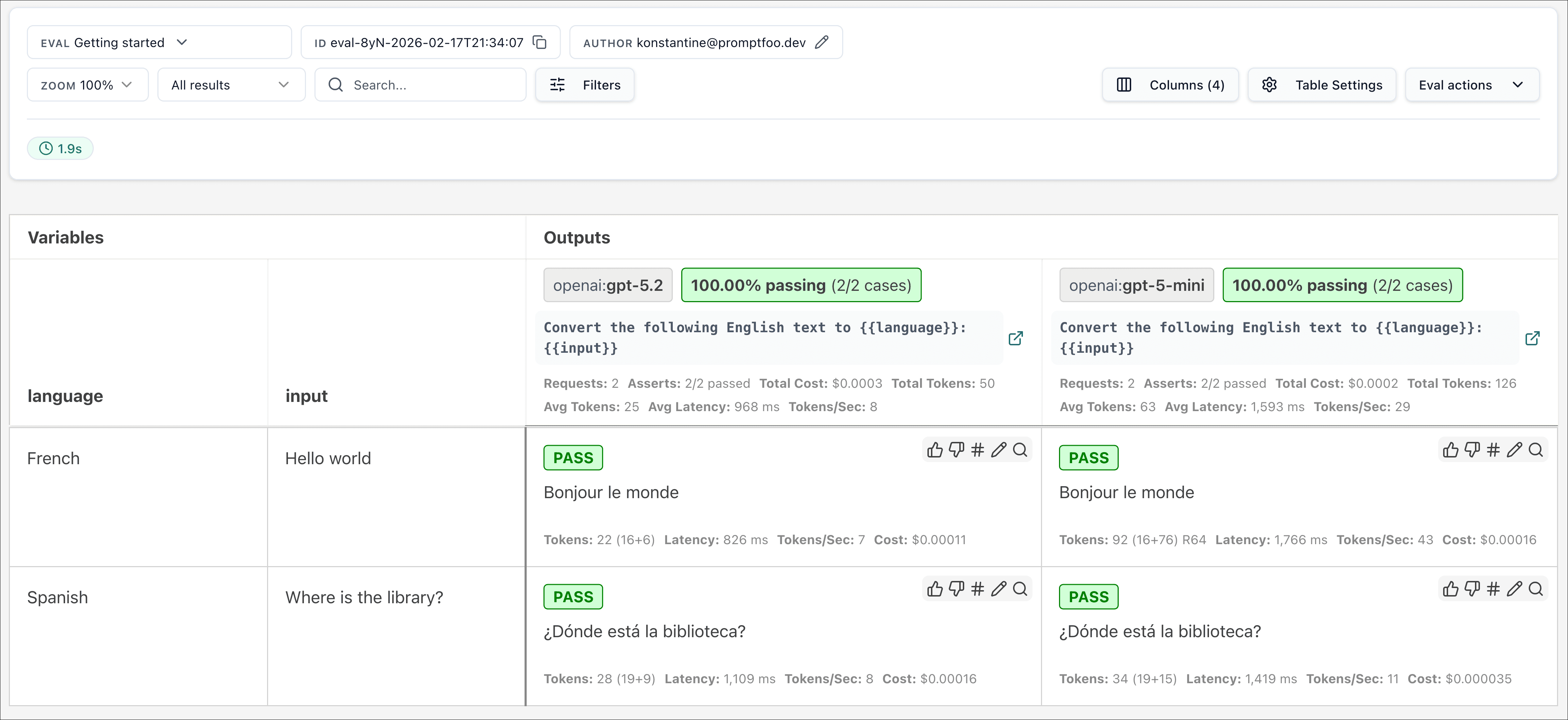
Review outputs: After the evaluation is complete, open the web viewer to review the outputs:
- npx
- npm
- brew
npx promptfoo@latest viewpromptfoo viewpromptfoo view
Asserts
The YAML configuration format runs each prompt through a series of test cases and checks if they meet the specified asserts.
Asserts are optional. Many people get value out of reviewing outputs manually, and the web UI helps facilitate this.
See the Configuration docs for a detailed guide.
Examples
The examples below cover a few common eval patterns: prompt quality, model quality, RAG quality, and agent quality.
Prompt quality
In this example, we evaluate whether adding adjectives to the personality of an assistant bot affects the responses.
You can quickly set up this example by running:
- npx
- npm
- brew
npx promptfoo@latest init --example eval-self-grading
promptfoo init --example eval-self-grading
promptfoo init --example eval-self-grading
Show YAML file for this example
# yaml-language-server: $schema=https://promptfoo.dev/config-schema.json
description: Automatic response evaluation using LLM rubric scoring

prompts:
  - file://prompts.txt
providers:
  - openai:gpt-6-sol
defaultTest:
  assert:
    - type: llm-rubric
      value: Do not mention that you are an AI or chat assistant
    - type: javascript
      # Shorter is better
      value: Math.max(0, Math.min(1, 1 - (output.length - 100) / 900));
tests:
  - vars:
      name: Bob
      question: Can you help me find a specific product on your website?
  - vars:
      name: Jane
      question: Do you have any promotions or discounts currently available?
From the newly created directory, run npx promptfoo@latest eval to execute this example:

This command will evaluate the prompts, substituting variable values, and output the results in your terminal.
You can also output a spreadsheet, JSON, YAML or HTML.
Model quality
In this next example, we evaluate GPT-6 Luna, Sol, and Astra on 15 riddles, each with an answer check. The full run makes 45 model calls plus grading calls. Cost and latency assertions check completed responses; they do not cap spending or stop slow requests.
You can quickly set up this example by running:
- npx
- npm
- brew
npx promptfoo@latest init --example compare-openai-models
promptfoo init --example compare-openai-models
promptfoo init --example compare-openai-models
Show YAML file for this example
# yaml-language-server: $schema=https://promptfoo.dev/config-schema.json
description: Comparing current OpenAI models on riddles

prompts:
  - 'Solve this riddle: {{riddle}}'

providers:
  - id: openai:gpt-6-luna
    config:
      reasoning:
        effort: low
      max_output_tokens: 2048
  - id: openai:gpt-6-sol
    config:
      reasoning:
        effort: low
      max_output_tokens: 2048
  - id: openai:gpt-6-astra
    config:
      reasoning:
        effort: low
      max_output_tokens: 2048

defaultTest:
  assert:
    # Example per-response cost threshold (USD)
    - type: cost
      threshold: 0.15
    # Example per-response latency threshold (milliseconds)
    - type: latency
      threshold: 60000

tests:
  - vars:
      riddle: 'I speak without a mouth and hear without ears. I have no body, but I come alive with wind. What am I?'
    assert:
      # Make sure the LLM output contains this word
      - type: icontains
        value: echo
      # Use model-graded assertions to enforce free-form instructions
      - type: llm-rubric
        value: Do not apologize
  - vars:
      riddle: "You see a boat filled with people. It has not sunk, but when you look again you don't see a single person on the boat. Why?"
    assert:
      - type: llm-rubric
        value: explains that there are no single people (they are all married)
  - vars:
      riddle: 'The more of this there is, the less you see. What is it?'
    assert:
      - type: icontains
        value: darkness
  - vars:
      riddle: >-
        I have keys but no locks. I have space but no room. You can enter, but
        can't go outside. What am I?
    assert:
      - type: icontains
        value: keyboard
  - vars:
      riddle: >-
        I am not alive, but I grow; I don't have lungs, but I need air; I don't
        have a mouth, but water kills me. What am I?
    assert:
      - type: icontains
        value: fire
  - vars:
      riddle: What can travel around the world while staying in a corner?
    assert:
      - type: icontains
        value: stamp
  - vars:
      riddle: Forward I am heavy, but backward I am not. What am I?
    assert:
      - type: llm-rubric
        value: Identifies the word ton and explains that reversing it spells not.
  - vars:
      riddle: >-
        The person who makes it, sells it. The person who buys it, never uses
        it. The person who uses it, doesn't know they're using it. What is it?
    assert:
      - type: icontains-any
        value: [coffin, casket]
  - vars:
      riddle: I can be cracked, made, told, and played. What am I?
    assert:
      - type: icontains
        value: joke
  - vars:
      riddle: What has keys but can't open locks?
    assert:
      - type: llm-rubric
        value: Identifies an object with keys that do not open locks, such as a piano or keyboard.
  - vars:
      riddle: >-
        I'm light as a feather, yet the strongest person can't hold me for much
        more than a minute. What am I?
    assert:
      - type: icontains
        value: breath
  - vars:
      riddle: >-
        I can fly without wings, I can cry without eyes. Whenever I go, darkness
        follows me. What am I?
    assert:
      - type: icontains
        value: cloud
  - vars:
      riddle: >-
        I am taken from a mine, and shut up in a wooden case, from which I am
        never released, and yet I am used by almost every person. What am I?
    assert:
      - type: icontains-any
        value: [graphite, pencil lead]
  - vars:
      riddle: >-
        David's father has three sons: Snap, Crackle, and _____? What is the
        name of the third son?
    assert:
      - type: icontains
        value: David
  - vars:
      riddle: >-
        I am light as a feather, but even the world's strongest man couldn't
        hold me for much longer than a minute. What am I?
    assert:
      - type: icontains
        value: breath
Navigate to the newly created directory and run npx promptfoo@latest eval or promptfoo eval. Also note that you can override parameters directly from the command line.
For example, if you run this command:
- npx
- npm
- brew
npx promptfoo@latest eval -r google:gemini-3.8-flash google:gemini-3.5-flash-lite
promptfoo eval -r google:gemini-3.8-flash google:gemini-3.5-flash-lite
promptfoo eval -r google:gemini-3.8-flash google:gemini-3.5-flash-lite
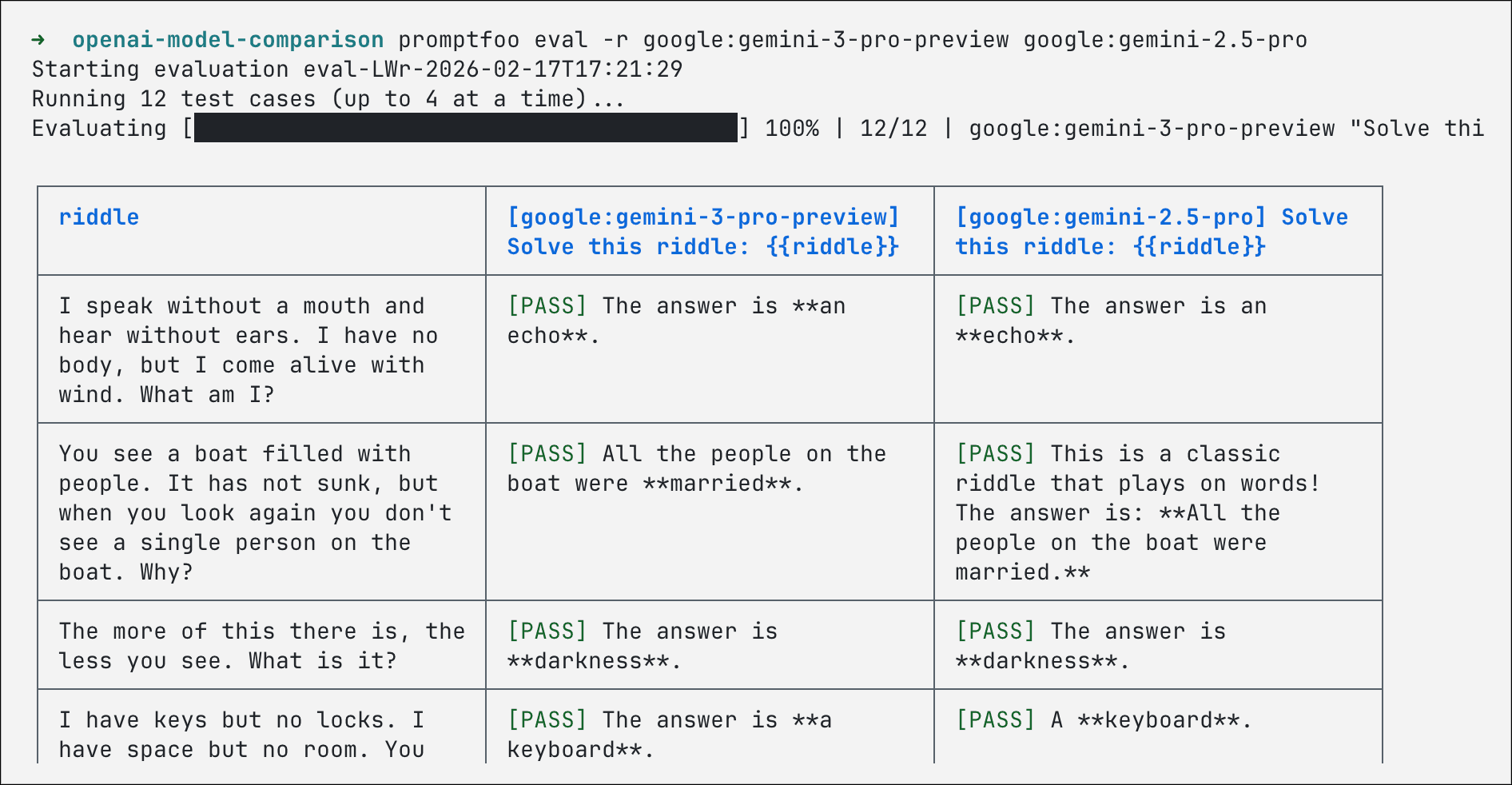
It produces the following table, with Gemini models replacing the GPT models in the config:
A similar approach can be used to run other model comparisons. For example, you can:
- Compare GPT-6 Luna reasoning effort settings (see GPT reasoning effort comparison)
- Compare models with different temperatures (see GPT temperature comparison)
- Compare open-source models (see Comparing Open-Source Models)
- Compare LLM chains with direct model calls (see Testing LLM chains)
RAG quality
In this example, we evaluate whether RAG outputs are factual, relevant, and grounded in the retrieved context.
You can quickly set up this example by running:
- npx
- npm
- brew
npx promptfoo@latest init --example eval-rag
promptfoo init --example eval-rag
promptfoo init --example eval-rag
From the newly created directory, run npx promptfoo@latest eval or promptfoo eval to grade outputs on factuality, answer relevance, context recall, context relevance, and context faithfulness. For a deeper walkthrough, see the RAG evaluation guide.
Agent quality
In this example, we evaluate an OpenAI Agents SDK workflow that uses tools for dice rolls, inventory checks, scene descriptions, and character stats.
You can quickly set up this example by running:
- npx
- npm
- brew
npx promptfoo@latest init --example openai-agents-basic
promptfoo init --example openai-agents-basic
promptfoo init --example openai-agents-basic
From the newly created directory, run npm install, then npx promptfoo@latest eval or promptfoo eval to test tool use and response quality across multi-turn scenarios. For task completion and trajectory checks, see the agent evaluation guide and tracing docs.
Next steps
Now that you've run your first eval, here are some ways to go deeper:
Customize your setup:
- Configuration guide - Detailed walkthrough of all config options
- Providers documentation - All 60+ supported AI models and services
- Assertions & Metrics - Automatically grade outputs on a pass/fail basis
Explore use cases:
- Agent evaluation - Test whether agents complete tasks and follow expected trajectories
- RAG evaluation - Test retrieval-augmented generation pipelines
- Red teaming quickstart - Scan your LLM app for security vulnerabilities
- CI/CD integration - Run evals automatically on every PR
Learn from examples:
- More examples in our GitHub repository